How to manage international car policies smarter
Companies that run corporate fleets across multiple countries are facing a number of challenges when it comes to managing and controlling car policies. In this article we will present solutions on how you can manage car policies on an international scale in a smart and efficient way.
As a professional Fleet Management Company, we, Fleets International Enterprises (FIE) serve many European wide clients, which are based across different industries. We are working in 35 countries for more than 12 years.
Based on our view onto the fleet market development in last couple of years, we see an ongoing trend of companies switching to a European Company Car Policy, which allows employees to choose a company vehicle, which fits individual requirements.
15 years ago, multinational companies tend to minimize European lease suppliers as well as Car Manufactures to chose from. The aim was to reduce internal workload by providing only pre-configured vehicles by using a single supply approach.
About 8 years ago, companies focused even more on reducing the spent within the cost intense fleet area. Saving money by using a single supply approach is that difficult as getting a sunburn in Liverpool. The multi supply strategies entered the fleet area and competition was brought to lease companies.
Today, 15 years after defining the very first fleet strategies across Europe, another element has been added to European wide Company Car Policies – Freedom of choice for employees.
Beside the factor to avoid cost and having a multi supply strategy in place, companies are looking for the best Human Resources within the individual markets. The company car is often mentioned during job interviews and can be an important detail of hiring talents.
Your car policy acts as the framework for all company car related topics. It contains rules and guidelines on how your employees are allowed to use and interact with their company car. We often see that clients put a lot of work into defining their car policy. As important as it is to do so carefully, we point out that this is just the first step.
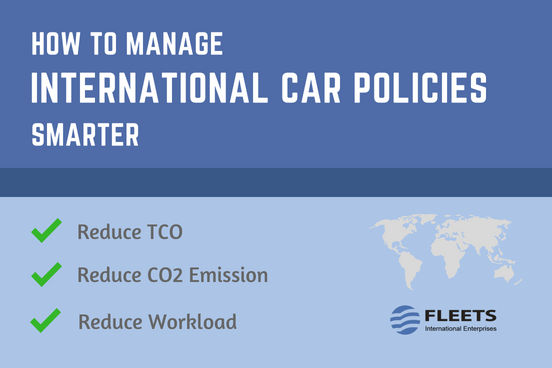
After your policy is set up and accordingly approved, the actual work begins. The quality of how well you implement, maintain and control it, are the key drivers that will decide if your policy meets the desired outcome. Possible objectives could be:
- Reduce overall TCO
- Reduce CO2 emission
- Increase driver satisfaction
- etc.
At FIE, we always prefer data-driven and process oriented approaches. Therefore we translate all written car policies into sets of rules that run in our cloud-based fleet management solution. As a result we are able to manage hundreds or even thousands of different car policies from a single point. This gives us more flexibility and more speed of execution when it comes to implementation, maintenance and control. We outline that there is only the system responsible for your worldwide car policy compliance. This builds the foundation of car policy success in our client base.
In the following sections we want to highlight the individual benefits in more detail.
Systemize your car policy
Systemizing your car policy means that you minimize manual work to ensure that drivers comply with the car policy accordingly. The larger your fleet size, the higher the impact will be. Let’s have a look at the fleet sourcing process as an example. By using a car configurator that represents all aspects like vehicle selection, mandatory equipment and own-contribution calculation, you can save a lot of time because you don’t need to manually validate vehicles against the car policy. The system has already completed this in realtime. Drivers will not be able to order vehicles that violate the car policy.
Scale your car policy
Another advantage of utilizing a centralized and cloud-based car policy management is the ability to scale. Whether it is a new country, a new entity or a new grade, you manage everything from one place. The only difference are the underlying rules. As we know from our daily work with clients, car policies can differ between countries and entities. The flexibility of an online-based control hub will give you an edge and reduces the implementation time substantially.
Minimize and identify violations
Our systemized approach puts the client into a position to minimize car policy violations or identify them to penalize drivers accordingly. One example could be an extensive overspending for fuel or car wash. Sometimes, drivers use their company fuel card to pay for car wash of family members. Our system identifies them easily and it is then the responsibility of the fleet manager to act appropriately.
Gain control of your KPIs
Most car policies are designed to deliver specific financial benefits to the company. The overall performance of these KPI’s is a result of the parameters defined in the car policy. Such parameters could be, OEM selection, minimum/maximum CO2 emissions or contract duration/mileage. With our cloud-based solution it’s just a matter of minutes to adjust these variables. This gives you a powerful way to steer your KPI’s into the right direction instantly.
The success of our clients has proven us right that centralizing and systemizing car policy management is a key benefit within our service. Think about the status-quo of your car policy management and we are sure that you will find multiple action points here to bring your company to the next level.
About FIE
At Fleets International Enterprises (FIE) we manage company car fleets of all sizes in different industries across multiple countries. Constant evaluation and improvement in data management has been key to an increased efficiency. Our experience has shown that investments in data management pay off, as they enhance processes and drive automation. Furthermore it provides insights to explore savings potential together with the clients.
Talk to us, if you are facing challenges in car policy management.

David Dahmer
David has been with the company since 2008 and leads FIE's software development division. He shares technical challenges that FIE and its customers are facing.
Let's talk about your fleet
Tell us how many vehicles you run and where — we reply within one working day.
Contact us